
Service Number: 86272
Regiment & Unit/Ship:
Machine Gun Corps
Date of Death
6th June 1918
Age 21 years old
Location of Death
France4
Place of Rest
Soissons Memorial

Charles Porter’s story was told in the Spring 2011 edition of the Odiham Society Journal and is reprinted below.
Charles Lindsay Porter, the third son of Arthur and Lynnie Porter, was born in Odiham in 1898. Fortunately, his service records have survived and give an overview of his experiences and movements from enlistment until he was killed in action[1]. We learn that he enlisted on 5 June 1916 at the age of 18 years and 5 months at Hartley Wintney, having previously been employed as a labourer. He was recorded as being 5’ 5” tall, with a chest measurement of 35” and weighing 129 lbs. On 6 June he became Private No. 30082 and was assigned to the Territorial Force 4th Battalion, Hampshire Regiment at Winchester, where he completed basic training. On 2nd October 1916 he was mobilised and the following day posted to another Territorial Force Battalion, the 5th Hampshire Regiment at Southampton. During his time with the 5th, he had one lapse of ‘conduct’, his offence being “dirty on parade (dirty clothing)” in Parkstone on 7 November 1916. It is likely that this was for something trivial, such as not cleaning the instep of his boots, as he received the minimum punishment of 5 days confined to barracks. However, six weeks later Charles was transferred to another unit, the 5th Battalion, Machine Gun Corps (MGC) and given a new number, 82672.
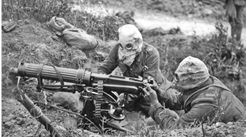
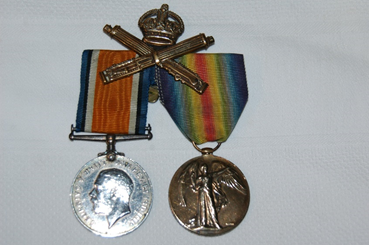
Transfer to this new unit would have involved a further period of specialist training over the next few weeks before Charles joined the British Expeditionary Force, France on 2nd March 1917 and a posting to the 137th Coy. MGC. He travelled to France from Folkestone to Boulogne and arrived at the Base Depot, Camiers, on 16th March, 1917 for onward transfer to the battle fields (see Fig.1 for a picture of an MGC gun crew in operation). On 18 August 1917 Charles was reported “wounded (Gas)” and the following day admitted to the shell gas ward of the field hospital. From here he was moved to the 22nd General Hospital in Dannes and then to other hospitals to convalesce, initially in Étaples (25th August) and then in Buchy (31st August). Two months later Charles was back at the Base Depot at Camiers (29 October). In early December he returned to the field with the 245th Machine Gun Company who were Divisional Troops in the 50th (Northumbrian) Division. After two weeks leave in England, during February 1918, Charles returned to his company which became part of 50th Battalion of the MGC in the same division. This battalion subsequently fought[2] at the battles of the Somme – at St Quentin on 21– 23 March as part of the XIX Corps, Fifth Army; in the actions at the Somme Crossings on 23rd March as part of the XIX Corps; and at Rosieres on 26 and 27 March as part of the XIX Corps, Fifth Army. They then moved on to the battle of the Lys, fighting at Estaires for three days from 9th April as part of the XV Corps, First Army; and Hazebrouck on 12 April, again with the XV Corps, First Army. On 26 April the Battalion was transported by train to the Aisne, joining the IX Corps under the 6th French Army on 28 April. On 6 May, the Battalion moved into the line taking over the Beaurieux Sector from the French. Three weeks later the battle of the Aisne began and continued until 6 June 1918 – the day that Charles was killed in action aged 21. His death is commemorated on the Soissons Memorial, Aisne, France and is one of nearly 4,000 casualties who died on the Aisne who have no known grave. He was awarded the British War Medal 1914-20 and the Victory Medal 1914-19 (Squeak and Wilfred) – see Fig.2.
[1] Ancestry.com. British Army WWI Service Records, 1914-1920 [database on-line].
[2] The Machine Gun Corps Old Comrades Association have kindly provided us with a pack of information about the MGC and Charles Porter, which includes details of the battles in which he would have been involved.
 Lance Corporal CHARLES PORTER Poppy Garden