

Service Number: --
Regiment & Unit/Ship:
Munitions Worker
Date of Death
27th October 1917
Age 21 years old
Location of Death
Odiham Cottage Hospital
Place of Rest
Odiham

Although Ellen, also known as Nellie, was born in Basingstoke in 1896, her grandfather, Alfred, had moved to Odiham some time before 1881 and become a ‘Licensed Hawker and Keeper of a Registered Lodging House’ at the Wellington Arms, in the High Street[1], living with his family at the premises. By 1901 Ellen’s father, Joseph was enumerated as Head of the household at the Wellington Arms, but his occupation was recorded as a ‘Rag and Bone Dealer’[2]. By this time Joseph was married to Hannah (k/a Annie) Digweed and had two sons and two daughters, one of whom was Ellen. In the late 19th century the Wellington Arms was “variously described as an ‘Ale and Boarding House with good lodging for travellers’ and as a ‘Common Lodging House and as an inn.’[3]
In 1905, Ellen’s father, Joseph, died at the age of 35 and in 1908 her widowed mother married George Adair. In 1911 the family, who were living in North Warnborough, consisted of George and Annie, their two daughters, Hilda and Kathleen, plus Ellen’s Scarrott brothers, Joseph, Thomas and Ernest, and sisters, Alice and Jennie[4]. Alfred, another brother, had died in 1903 aged 3. Ellen was not with the family on census night, but was staying with her Aunt Ellen, formerly Scarrott, and uncle, John Baker, in Bickley, Kent[5].
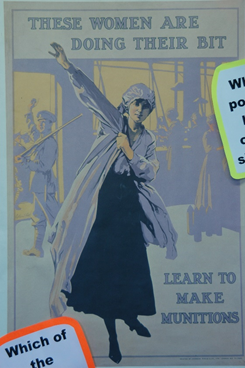
There are no more records of Ellen’s life until her death from TNT poisoning at The Cottage Hospital, Odiham on 27 October, 1917. Her death certificate records her occupation as ‘a worker in Munition Factory’, which is thought to have been at Newnham. It is possible that she responded to a call for women workers (See Fig.2) to replace the men who went off to war after conscription was introduced in March 1916. The pay for this type of work was better than for traditional women’s jobs and those employed in this type of industry, traditionally a male only preserve, enjoyed greater independence.
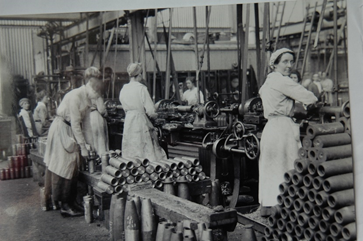
However, the work was risky and dangerous, particularly because of the exposure to TNT when handling shells. Ellen was one of 400 women who died from over exposure to TNT during the war. Following her death, her mother and family desired ‘to tender their sincere thanks for the many expressions of sympathy received in their recent sad bereavement, especially to the fellow employees of the late Ellen Scarrott.’[6] She certainly deserved her place on the Odiham War Memorial.
[1] 1881 Census, Odiham, ref: RG11; Piece: 1249; Folio: 8; Page: 9
[2] 1901 Census, Odiham, ref: RG13; Piece: 1102; Folio: 28; Page: 12
[3] Millard, Sheila, 2008, Last Orders, Please!, p.17, The Odiham Society
[4] 1911 Census, Odiham, ref: RG14PN6246 RG78PN296 RD109 SD1 ED12 SN179
[5] 1911 Census, Bickley, Kent, ref: RG14PN3646 RG78PN137 RD42 SD1 ED17 SN65
[6] Notice in the Hants and Berks Gazette, 10 November 1917
 ELLEN SCARROTT Poppy Garden