
Service Number: 7288
Regiment & Unit/Ship:
1st Bn., The Hampshire Regiment
Date of Death
28th August 1914
Age 25 years old
Location of Death
France
Place of Rest
La Ferte-sous-jouarre Memorial

Frederick, the son of William, a platelayer, and Rebecca Porter was born in Potbridge, Odiham, on 22 November 1888[i]. He was the youngest of ten children, although four of the older siblings had died during the period 1881 – 1882[ii]. In 1891, the family home included his parents and five siblings, Albert (10), Elizabeth (8), Harriet (7), Alice (5) and Frederick (2)[iii]. He attended London Road Board School from 23 November 1896[iv]. His father, William, would have worked for the London and South Western Railway and been based at nearby Winchfield Station. Some time after leaving school Frederick enlisted in the Army, probably in 1904 as suggested by his Regimental service number. He would have been 15 or 16 at the time. In November 1906 he was awarded a 1st Good Conduct Medal[v]. In January 1908 Frederick transferred to the Army Reserves[vi]. On his return to civilian life Frederick followed in his father’s footsteps and became a railway platelayer, the occupation given in the 1911 census[vii]. On 31st July 1914 Frederick became the father of daughter, Florence, born to Mabel Gubby[viii]. When war was declared a few days later Frederick re-joined his original battalion.
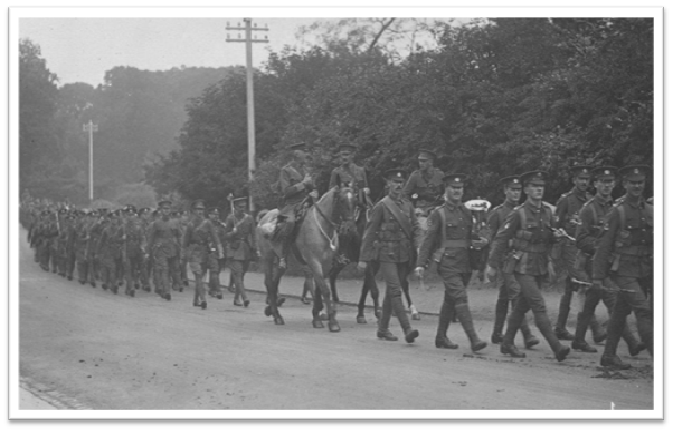
Nearly a year before the start of the war on 4 August 1914 the 1st Battalion, the Hampshire Regiment, had moved from its base in Aldershot to Colchester and from the Second Division to the Fourth. On 29th July orders to adopt “precautionary period’ measures were issued, but general mobilisation was to be delayed as long as possible. However, a total of 500 Reservists reported in between the 1st and 9th August. Frederick was one of these Reservists[ix]. Two weeks of preparation and training prior to joining the British Expeditionary Force in France followed. Route marches formed part of this preparation as can be seen in Ill. 1. On 17th August they assembled near Harrow, before travelling by train to Southampton and embarkation on the Braemar Castle and the Cestrian for the journey to Le Havre. They entered the France and Flanders theatre of war on 23 August 1914[x].
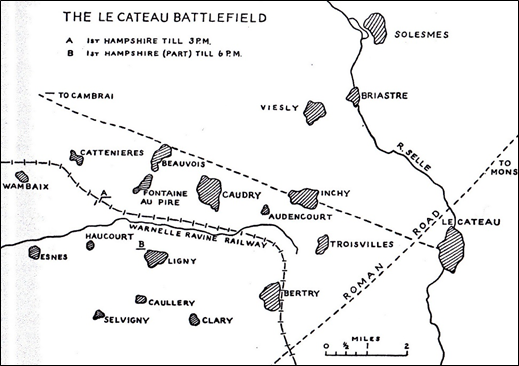
Early in the morning of 24th August the 1st Hampshire began a 24-hour train journey to Le Cateau. After detraining they had a quick breakfast before marching onwards to Solesmes, some six miles away, in very hot weather[xi]. Here they were in position to cover the retirement of the 5th Division from Mons moving on to Briastre in late afternoon and holding this village until midnight. Three hours later, the early hours of 26th August, they moved on to Le Coquelet, where they bivouaced for an hour[xii]. See Fig.1 for a map of the Le Cateau battlefield area.
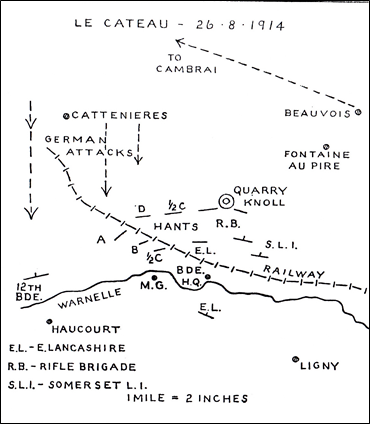
Bettween 04.00 and 05.00 the 11th Brigade moved to a position by the railway line about one mile north of Ligny, the 1st Hampshire being flanked on the left by the Somerset Light Infantry, on the right by the 1st Rifle Brigade and the 1st East Lancashire to the rear (see Ill.2). Two platoons of B Company remained behind to provide cover for the rest of the Battalion, sustaining ten casualties from enemy artillery fire before they, too, joined the rest of the Brigade. During the day D and A Companies suffered losses due to enemy action. By the end of the day six other ranks were reported killed and 40 other ranks were missing. We do not know which Company Frederick fought with but he was one of those killed in action on the Le Cateau battlefield on 26th August 1914[xiii].
Frederick Porter, killed in action only 22 days after the start of the Great War, and was its first Odiham casualty. He was awarded the 1914-15 Star, the British War Medal and the Victory Medal[xiv]. He is commemorated on the La Ferte-sous-Jouarre memorial on the south bank of the River Marne, the 1914-1918 Roll of Honour of the rail ‘Company’s employees who gave their lives in the Great War’ at Waterloo Station and in The Hampshire Roll of Honour book in Winchester Cathedral.
[i] Source – London Road Board School Register of Admissions from 1885
[ii] Details provided by family member
[iii] 1891 Census, Odiham, Hampshire, ref. Class: RG12; Piece: 953; Folio: 43; Page: 13.
[iv] Source – London Road Board School Register of Admissions from 1885
[v] Source – The Hampshire Regimental Journal, November 1906, p.256
[vi] Source – The Hampshire Regimental Journal, Vol. III, January 1908, p.17
[vii] Source – 1911 Census, Odiham, Hampshire, ref: Class: RG14, Piece: 6247
[viii] Details kindly given by Jean de Cartier, the grand-daughter of Frederick Porter and Mabel Gubby
[ix] Source = Regimental History of the Royal Hampshire Regiment, Vol.2, T Atkinson, p.3
[x] Source = Regimental History of the Royal Hampshire Regiment, Vol.2, T Atkinson, pp. 4-5
[xi] ibid.
[xii] Source – 1st Bn. The Hampshire Regiment War Diary, ref. M1889, 22-26 August 1914
[xiii] Source – 1st Bn. The Hampshire Regiment War Diary, ref, M1889, 26 August 1914
[xiv] Source – British Army WW1 Medal Rolls and Index Cards, 1914-1920. www.ancestry.co.uk
 Private FREDERICK PORTER Poppy Garden