
Service Number: 27232
Regiment & Unit/Ship:
Machine Gun Corps
Date of Death
28th October 1918
Age 28 years old
Location of Death
Italy
Place of Rest
Cremona Town Cemetery
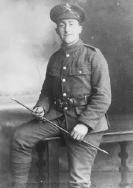
Harry Clinker was the second son, but third child of Samuel Henry, a journeyman printer, and Marie Clinker. He had six younger brothers and sisters, and the family lived in the High Street, Odiham[1]. He was born on 3 June 1890 and in 1894 he started at Buryfields School[2]. Three years later on 8 March 1897 he transferred to the London Road Board School[3]. After leaving school he worked as a butcher’s cIerk, initially at A.J. Parsons Ltd. in Odiham[4] and later for some years at the Fleet branch in Fleet Road where, in 1911 he was also boarding[5]. He appears to have been a keen sportsman, who enjoyed playing cricket, football and other games[6].
On 20th August 1915 Harry attested for Short Service and joined the 16th Bn., Royal Fusiliers at Purfleet[7]. The Machine Gun Corps was formed in October 1915 and Harry transferred with a new service number, 27232, to the 23rd Battalion of the Infantry section of this Corps. In March 2016 he joined the Battalion on the Western Front[8], and saw active service on the Somme and in other battles during the following months. In November 1917 when things in Italy worsened, the 23rd Division was moved to Mantua and Marcaria initially, before taking over the front line at Montello on 4 December.[9] During the campaign in Italy, the 23rd Division was involved in fighting on the Asiago Plateau in June and then on 26 October in the Battle of Vittorio Veneto, which included the passage of the Piave between 26 and 28 October[10]. It was on the 27 October that Harry was admitted to the 29th Stationary Hospital suffering from influenza, probably the Spanish Flu, which was rife at the time, and bronchial pneumonia, illnesses from which he did not recover.[11]
Harry was buried in Cremona Town Military Cemetery in Italy, as shown in the photograph below, which was sent to the Clinker family[12]. He was awarded the Victory Medal and the British War Medal[13].
The Infantry Branch was by far the largest and was formed initially by the transfer of battalion machine gun sections to the MGC.
The MGC saw action in all the main theatres of war, including France, Belgium, Palestine, Mesopotamia, Egypt, Salonika, East Africa and Italy. In its short history the MGC gained an enviable record for heroism as a front line fighting force. Some 170,500 officers and men served in the MGC with 62,049 becoming casualties, including 12,498 killed, earning it the nickname ’the Suicide Club’.
[1] Source – 1901 Census, Odiham, Hampshire, ref. Class: RG13; Piece: 1102; Folio: 45; Page: 16
[2] Source – National School Admission Registers & Log Books 1870-1914, findmypast.co.uk
[3] Source – London Road Board School Admission Register
[4] Source – Obituary in Hants & Berks Gazette, 9 November 1918
[5] Source – 1911 Census, Fleet Hampshire; ref. RG14PN6241 RG78PN296 RD109 SD1 ED7 SN67
[6] Source – Obituary in Hants & Berks Gazette, 9 November 1918
[7] Source – British Army Service Records, Harry George Clinker – www.findmypast.co.uk
[8] Source – Obituary in Hants & Berks Gazette, 9 November 1918
[9] Source – The Long, Long Trail, history of the 23rd Division – www.longlongtrail.co.uk
[10] Source – ibid
[11] Source – Obituary in Hants & Berks Gazette, 9 November 1918
[12] Photographs kindly provided by the Clinker family
[13] The National Archives Catalogue reference: WO/372/4, image ref. 21552
 Private HARRY GEORGE CLINKER Poppy Garden