
Service Number: 7157
Regiment & Unit/Ship:
1st Bn., The Hampshire Regiment
Date of Death
1st November 1914
Age 28 years old
Location of Death
Killed in Action
Place of Rest
Ploegsteert Memorial

John McAvoy was born on 16 November 1885[i] to Mary, the daughter of James, a brickyard labourer, and Eliza Wooldridge of Potbridge, Odiham and John McAvoy, a Private with the Argyll and Sutherland Highlanders based at North Camp, Farnborough. John was baptised at All Saints Church, Odiham on 16th December 1885[ii] and was subsequently raised by his grandparents in Potbridge. He grew up living near Frederick Porter and his family. John attended the London Road Board School from 4 April 1892 until 12 June 1897, when he ‘left for work’[iii]. Possibly he immediately worked as a navvy on the railway, as this was his given occupation in 1901[iv]. Like Frederick he enlisted in the Army, joining the 1st Bn. The Hampshire Regiment a little earlier, judging by his given service number. In May 1906 John extended his service for a further nine years[v] and in June 1906 he was granted a First Good Conduct Badge[vi]. However, he apparently lost this for in November 1909 we find that this badge was restored[vii]. In 1911 John was stationed with his battalion at Badajos Barracks, Wellington Lines, Aldershot[viii] until, as we have seen above, they moved to Colchester in the autumn of 1913.
After war was declared John and Frederick would have shared many of the same experiences, both having entered the France and Flanders theatre of war on 23rd August 1914. Frederick’s death so soon after arriving at the Western Front must have been painful for John to bear, but there were many more battles to be fought. As the Hampshires retired from the battlefield to reform near Ligny on the 26th August, one officer recorded that it seemed “as if every gun and rifle in the German Army had opened fire”[ix]. By 9.00 pm, they reached Serain, some twenty miles from Briastre, to rest for a few hours, refreshed by hot water and bread supplied by the villagers. It had been a long day with heavy losses all round. Before dawn on 27th August a march southward towards the Marne and Aisne trenches and battlefields began.
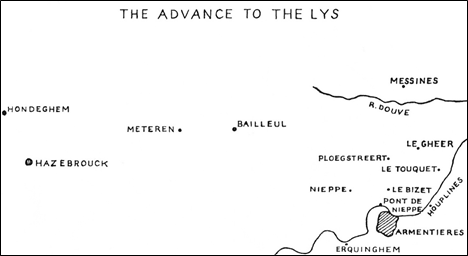
At 7.00 pm on 6th October the move to Flanders began with a march to Ville-Montoire and billets for the night, en route to take part in the battle of Armientieres and the defence of Ploegsteert Wood. The next few days were spent mainly advancing towards the Lys during the afternoons or evenings. They reached Bailleul as advanced-guard to the Division on 14th Octoberxi[x] (see Fig.1).
The Germans were substantially reinforced on 20th October and three Hampshire Companies sent forward to trenches east of Armentieres to support the Division’s line (See Fig.4) and in so doing came under heavy shelling. The next day most of the Battalion marched to billets in Ploegsteert and from 23rd to 27th October all Companies were either occupying reserve trenches or digging reserve trenches. On 28th October, the Battalion relieved the Somerset Light Infantry in the line 1100 yards opposite the parallel German trenches (see Fig.2 for positions)[xi]
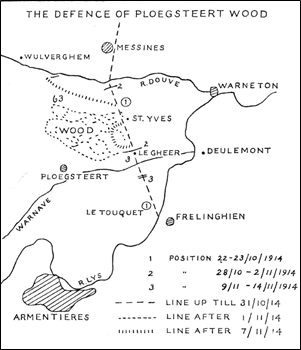
Early in the morning of 30th October the Germans subjected them to a major bombardment. This continued until 4.00 pm, and was followed by an advance by the enemy infantry which continued until darkness fell. This action was repeated the next day with all but one member of a platoon of C Company being lost. On November 1st the heavy bombardment with German attacks along the entire Battalion line continued. On this day, twenty other ranks were killed, nineteen were wounded, three were missing in action[xii]. John McAvoy was one of those missing in action, for his grandmother was not officially notified of his death until the end of January 1915[xiii]. He was awarded the 1914-15 Star, the British War Medal and the Victory Medal[xiv]. He is commemorated on the Ploegsteert Memorial and in The Hampshire Roll of Honour book in Winchester Cathedral.
[i] London Road Board School Register of Admissions from 1885
[ii] Odiham Parish register of baptisms
[iii] London Road Board School Register of Admissions from 1885
[iv] 1901 Census, Odiham, Hampshire, ref. Class: RG13; Piece: 1102; Folio: 64; Page: 12.
[v] Source – The Hampshire Regimental Journal, Vol. 1, May 1906, p.127
[vi] Source – The Hampshire Regimental Journal, June 1906, p.146
[vii] Source – The Hampshire Regimental Journal, November 1909, Vol. 4, p.223
[viii] Source – 1911 Census, Aldershot, Hampshire, ref: Class: RG14, Piece: 3123; Schedule Number: 9999.
[ix] Source – Regimental History of the Royal Hampshire Regiment, Vol.2, T Atkinson, p.11
[x] Sources – ibid, p.27 and the 1st Bn Hampshire Regt. War Diary, ref: M1889, October 1st – October 15th 1914
[xi] Source – The 1st Bn. Hampshire Regiment War Diary, ref: M1889, October 16th to October 28th 1914.
[xii] Source – The 1st Bn. Hampshire Regiment War Diary, ref: M1889, October 28th to November 1st 1914
[xiii] Source – Hants and Berks Gazette, 6 February 1915
[xiv] Source – British Army WW1 Medal Rolls and Index Cards, 1914-1920. www.ancestry.co.uk
 Private JOHN MCAVOY Poppy Garden