
Service Number: 9030
Regiment & Unit/Ship:
1st Battalion, Border Regiment
Date of Death
17th August 1917
Age 26 years old
Location of Death
France
Place of Rest
Dozinghem Military Cemetery
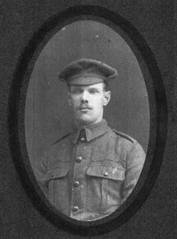
Albert Moody was born in Odiham on 6th October 1890. He was the third son of Charles, a tinsmith, and Ellen Moody, who lived at Chapel Pond, North Warnborough[1]. Five of the seven brothers fought in the War, the remaining two being too young to serve with the colours. Albert’s death came four months after that of his younger brother, Reginald, who had been shot down by Oberleutnant Werner Voss on 4 March 1917, as reported in the last Journal.
Albert’s Army career began in 1906, when at the age of 16 he enlisted at Basingstoke, passed a medical examination at Winchester and joined the Border Regiment. Apparently this was a good year for recruitment to the Border Regiment, especially in London, but also other parts of southern England. His Attestation form completed on 25 October 1906 included his full personal details and gave his occupation as ‘engineer’[2]. Two days later Private Moody travelled to the Regiment Depot in Carlisle. The 1st Battalion remained in England until 1908 when it was moved to India initially and then Burma. In June 1914 Albert’s assessment on his service record employment sheet was excellent. His military character was “Very Good””; he had no instances of drunkenness on or off duty;” and his character from civil employment point of view was – “A quiet steady man. An excellent worker. Intelligent and trustworthy.” The nature of his employment since his last assessment was “Armourers Shop, Type writer in orderly room, Garrison Police – Gibraltar”[3]. At this time the Battalion was stationed at Maymyo in Burma where it remained until 9 December 1914 when it embarked for a return to England to join the 87th Brigade of the 29th Division.
On 17 March 1915 the 1st Battalion were mobilised for war in Gallipoli, embarking at Avonmouth. Once in the Dardanelles Albert was promoted, becoming an unpaid Lance Corporal in May. The following month he was sick and admitted to the base hospital, rejoining the Battalion a month later[4]. Two months after that Albert was again admitted to hospital suffering from dysentery[5]and shellshock, which affected his hearing. He convalesced in Malta and then returned home in England[6]. At this time the 29th Division in Gallipoli was suffering heavy casualties from combat, disease and bad weather and in January 1916 the decision was taken to evacuate the remaining troops to Murdos and then Alexandria.
In March 1916 the Division moved to the Western Front in France and Flanders and in June Albert was granted “a furlough from 16 -26 June” and was now considered to be “fit for light duty”. So he had ten days back in Odiham. During 1916 the Battalion was involved in the Battles of Albert and Transloy Ridges. It was in 1917 that Albert was promoted to Lance Sergeant in the same Battalion with effect from 25 May. However, it was also the year that three months later he was wounded in action and died of these abdominal wounds shortly afterwards on 17 August 1917[7].
Albert’s possessions, which included letters, photos, a wallet, an old watch, a handkerchief, two notebooks, one bullet, a horseshoe pendant, a button, a knife and three postage stamps were sent to his mother just before Christmas 1917. This may have been too much for his father, who shot himself with a revolver a few weeks later.[8]
Albert is buried in Dozinghem Military Cemetery. He was awarded the 1915 Star, the British War Medal 1914-20 and the Victory Medal 1914-19[9].
[1] Source – The London Road Board School Admission Register
[2] Source – Albert Moody’s Army Service Record – www.Ancestry.co.uk
[3] Source – ibid
[4] Source – ibid
[5] Source – ibid
[6] Obituary, Hants and Berks Gazette, 1 September 1917
[7] Source – ibid
[8] Source – Obituary, Hants & Berks Gazette26 January 1918
[9] British Army WW1 Medal Rolls Index Cards, 1914-1920, www.ancestry.co.uk
 Lance Serjeant ALBERT EDWARD MOODY Poppy Garden