
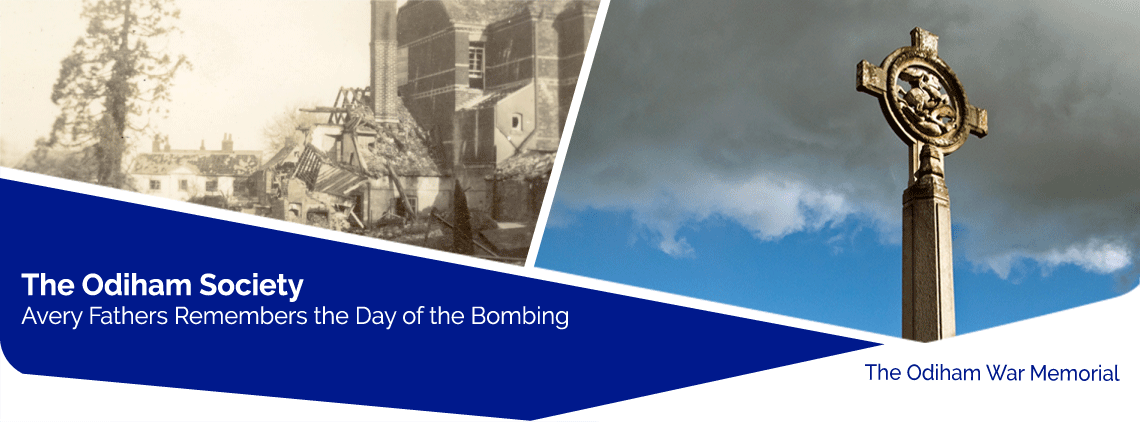
AVERY FATHERS REMEMBERS THE DAY OF THE BOMBING
Avery fathers recalls the afternoon of 18th October 1940
OCTOBER 18th 1940
On the afternoon of October 18th 1940, I, as an 8 year old, was waiting at our house (now 127 High Street) for my mother t return from the recently opened Forces canteen (now Lloyd’s Pharmacy) to take me to spend some of my pocket money at Mrs. Hamilton’s sweet shop, when I heard the sound of machine-gunning. I rushed down to the cellar (our air raid shelter) where lots of apples were laid out on shelves. As the house shook when the first bomb fell, the apples jiggled about dramatically. My mother had seen the· very low plane, a Junkers 88, drop the fifth bomb and tried to get back home. But the sky was full of dust and the road full of debris so she feared her family had all perished till she heard my screams.
Mr Sims, manager of Lloyd’s Bank, was returning from picking up his two children from Mrs. Mac’s little school on Dunleys Hill and came in to ask “If I’d like to come and play with Alan and Geraldine”. So, clambering over the debris in the High Street, I went there. A little later a Canadian from RAF Odiham came to offer assistance and my mother asked him to take my doll’s pram (which I was sadly missing) down to the Bank House and this he nobly did. Fortunately, for some reason, I had covered the dolls with a thick blanket so apart from a broken china nose they had survived unscathed
I had been shown their air raid shelter (the Bank’s strong room) and when the time bomb went off at 9 pm, blowing out the front windows of 127, I dashed down there and there and refused to come up for the rest of the night.
Mrs Hamilton was sadly killed as her sweet shop was completely destroyed.
Another of the victims named on the War Memorial is Alfred Vellacott, a distant cousin, who had come a few days earlier to escape from the bombardment at home to the safety of Odiham.
The sound of machine-gunning came from the plane flying low over Robert May’s School (now Mayhill School). The lookout for the cadets, parading on the playground, had seen a German plane approaching. and signalled to them to take cover. The playground was strafed. That night Lord Haw-haw said that the “army barracks” at Odiham had been destroyed.
My grandmother and great aunt, both severely injured, were eventually taken to Park Prewett as the other local hospitals were all full. With all the rubble in the High Street there was no way the ambulance in Alton Road could reach the Cottage Hospital without a very long detour. As Church Street was blocked, the passage at l27 was used as a way through and there was quite a bit of looting (my great aunt’s silver backed hair brushes were discovered later in the garden).
We were out of our home for nine months, and during the rebuilding electricity (but only one power point in each room) was installed for the first time. The authorities had wanted to demolish the house and widen Church Street, but Miss Chamberlain insisted that her wall at the narrow top end of Church Street could not be touched, and Margaret Gill’s father, an eminent architect, drew plans for the restoration of the house.
MEMORIES OF THAT FATEFUL DAY IN 1940 REMAIN CLEAR EVEN AFTER 75 YEARS.
Postscript: Roger James interviewed Avery Fathers’ Mother on the subject some years ago at a Church event. He recalls the following two stories, which add to our knowledge of the day’s events.
The Head Teacher at Buryfields was a stickler for time For the one and only recorded time she was late ringing the bell for the end of school. Had she been on time, children would have been on the street at the time of the bomb.
After the bombing, when the first people entered the wrecked building, they found a group of cats, allegedly sitting in a circle protesting. I have seen a drawing of this somewhere. It may be a Ray Millard drawing.