
Coinage at the time of King John and Henry III
SHORT-CROSS SILVER PENNY – KING JOHN
The short-cross silver penny, named because of the short voided cross in the inner circle on the reverse of the coin, was born in 1180 and would run for 67 years through the reigns of Henry II, Richard I, John and Henry III.
AN EXAMPLE OF A SHORT-CROSS PENNY
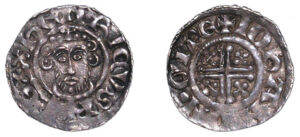
The legend on the obverse (head) side reads “HENRICVS REX” . The reverse has the moneyer and mint and reads “ IOHAN ON GIPE”- John of Ipswich around a short armed cross.
The forward facing king on the obverse (face) always read HENRICVS REX (Henry, King) regardless of whether the king was called Henry, Richard or John. There were no English coins bearing the name Richard or John although Richard did issue some coinage in France and John, in Ireland.
The styles of the short cross pennies, over the sixty-seven years, were all so similar, that in 1915 they were assigned to classes, based on minor changes to the design, by Dr L A Lawrence.
They are numbered from Class 1 to Class 8.
- Class 1 are Henry II coins issued from 1180 to the death of the king in 1189
- Classes 2-4 are issues of Richard I issued from 1189-1199
- Classes 4-6 are issues of John issued from 1199-1216
- Classes 6-8 are issues of Henry III issued from 1216-1247
The ‘die’ – the tool used to strike a coin bearing the design of the coin to be impressed on the blank, was made by hand. A set of metal punches were used to form the image and letters on the die.
There was only one coin at this period so the coin was designed to be cut and the cross was designed to make it easier to divide the coin into halves and quarters.
A SILVER SHORT-CROSS PENNY FOUND IN ODIHAM
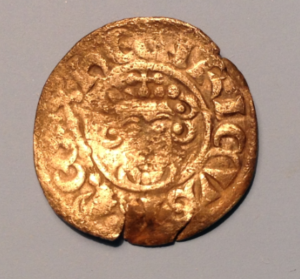
The legend on the head side reads “HENRICVS REX”. The reverse has the moneyer and mint and reads WILLELM L On London around a short armed cross.
This is a type 5B-5c silver short-cross penny from King John’s reign.
Actual size: Diameter 10mm (3/4 inch)
THE LONG-CROSS SERIES- HENRY III
During the reign Henry III, in 1247, the long cross series was introduced in order to prevent the coinage of the country being clipped – where people would remove slivers of precious metal. The long-cross also made easier the task of cutting the coin into halves and quarters, thus producing halfpennies and farthings, as no round small change would appear until Edward I’s [1272-1307] reform in 1279. The need for small change was extremely acute. A penny, which represented approximately a day’s pay for a skilled labourer, would buy two dozen eggs, two large loaves of bread or at least two gallons of ale. Henry 111 (1216-1272) voided (cross goes right to the edge) Long Cross halfpenny – found in Odiham
REFERENCES:
- The Short-Cross coinage in 1180-124 Henry II to Henry III. An illustrated guide to identification by Christopher R Wren.
- The Short Cross Penny 1180 – 1247 by Æthelin