
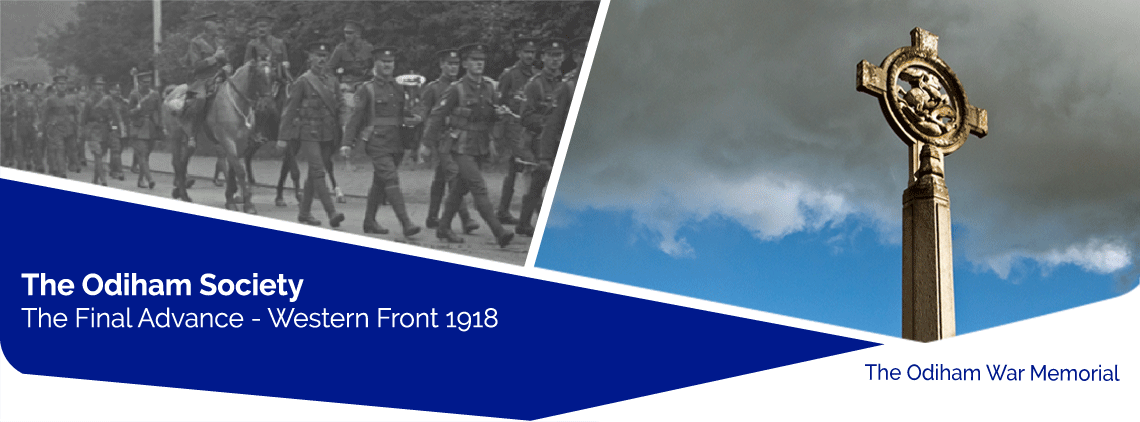
THE HAMPSHIRE REGIMENT - THE FINAL ADVANCE
The period 8th August – 11th November 1918, commonly known as the ‘Final Advance’ or the ‘Hundred Days’, saw the decisive Allied offensives of the First World War on the Western Front. Having stemmed the German attacks of the spring and summer of 1918, the British and French armies, supported by increasingly large numbers of American troops, embarked on a series of operations against the weakened and war-weary German forces. Five Hampshire battalions – the 1st, 2nd, 2/4th, 11th and 15th – played conspicuous roles in the Allied drive to victory.
The first phase aimed to eliminate the three huge salients created by the German offensives – on the Marne, on the Somme around Amiens and at St Mihiel, south of Verdun. This phase saw the British Fourth Army score a major victory at the Battle of Amiens on 8th August with a surprise attack spearheaded by 580 tanks. British, Australian and Canadian troops destroyed six German divisions as they advanced nine miles in one day.
Having cleared the salients, the Allies then embarked on the second phase of operations. This targeted the strong defensive positions to which the Germans had retreated. The task of breaking through the Hindenburg Line was assigned to the British First, Third and Fourth Armies. The battle began on 27th September with an attack on the Canal du Nord, followed two days later by the main assault on the St Quentin Canal. Faced with major offensives at three points, the Germans no longer had the resources to plug breaches in their line and on 3rd October, after bitter fighting, the Hindenburg Line was broken.
Despite this crushing blow, the retreating German Army continued to resist stubbornly as it attempted to hold up the Allies. However, by this stage the outcome of the war was not in doubt. As early as 29th September – the day that Germany’s ally Bulgaria began armistice negotiations – the German High Command had informed the Kaiser that the war could no longer be won on the battlefield.
There was increasing unrest, too, on the home front where the effects of the Allied naval blockade were hitting hard. Sacrifices that had been acceptable while the German armies were advancing were not tolerable now they were in retreat. On 27th October Ludendorff was ordered to resign and three days later Turkey surrendered. With her one remaining ally, Austria-Hungary, disintegrating, Germany was finally forced to negotiate with the Allies. Following the signing of an Armistice, the war came to an end at 11am on 11th November 1918.
There was increasing unrest, too, on the home front where the effects of the Allied naval blockade were hitting hard. Sacrifices that had been acceptable while the German armies were advancing were not tolerable now they were in retreat. On 27th October Ludendorff was ordered to resign and three days later Turkey surrendered. With her one remaining ally, Austria-Hungary, disintegrating, Germany was finally forced to negotiate with the Allies. Following the signing of an Armistice, the war came to an end at 11am on 11th November 1918.
The start of British involvement in the Final Advance is normally dated from the opening of the Battle of Amiens on 8th August 1918. However, 2/4th Hampshirewas one of a number of British units that saw action in mid-July at the Second Battle of the Marne, considered by some to mark the true turning of the tide on the Western Front.
Having arrived in France from Palestine on 1st June, the 2/4th Hampshire was assigned to 62nd Division and went into the line near Bucquoy a fortnight later. On 15th July, the Germans launched a major offensive around Rheims and the battalion was immediately sent to the Forest of Courtagnon, south-west of the city. On 20th July, they formed part of a week-long assault by 62nd Division along the Ardre valley in which it helped capture the German strongpoint of Marfaux along with the neighbouring villages of Cuitron and Bligny.
The Hampshires suffered heavy casualties during a week of hard fighting on the Ardre, losing two officers and 172 men killed and missing with nine officers and 170 men wounded.
For the Germans, however, the battle was a disaster. Not only did they lose many men – observers said they had never seen ground so thickly strewn with German dead as in the Ardre valley – but they had been forced into headlong retreat. Never again would the German Army possess the strength to mount a major offensive on the Western Front.
The Allies enjoyed overwhelming air superiority during this advance to victory – a great advantage.
Source www.royalhampshireregiment.org