

THE HAMPSHIRE REGIMENT - 3RD YPRES 1917

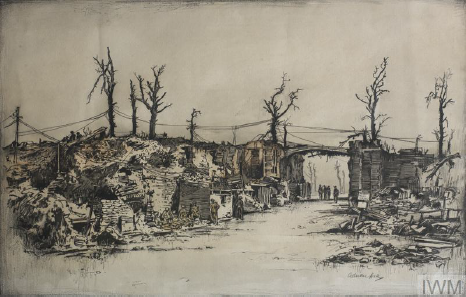
The Third Battle of Ypres, more commonly known as the Battle of Passchendaele (after the Flemish village which was the final objective captured by British and Empire troops), was a major Allied campaign in Flanders. Its strategic aim was to break through German defences and capture German naval bases on the Belgian coast from where U-Boats were launching attacks on British Royal Navy and merchant ships. The campaign failed to achieve this objective, but did inflict heavy casualties on the German Army.
Third Ypres was preceded by the Battle of Messines (7-14 June 1917) which opened with the British exploding 19 huge mines under German lines. The attack, in which 15th Hampshire took part, succeeded in capturing the strategically important high ground along the Messines ridge and paved the way for the much larger operation further north which began on 31st July.
14TH HAMPSHIRE AND THE BATTLE OF PILCKEM RIDGE
Rather than one battle, the Third Ypres campaign was in fact a series of operations. The first of these, the Battle of Pilckem Ridge, began on 31 July 1917. The 14th Hampshire were in action as part of 41st Division’s attack, where 2nd Lieutenant Hewitt was awarded the Victoria Cross for his gallantry before he was shot and killed by a sniper.
2ND HAMPSHIRE AND THE BATTLE OF LANGEMARCK
The Battle of Langemarck (16-18 August 1917) was the second Allied attack of the Third Ypres campaign. On the night of 15 August the battalion moved across very boggy ground to an assembly point northeast of Pilckem. At 4.45am the following day the Hampshires advanced behind an accurate creeping barrage and secured their two principal objectives.
15TH HAMPSHIRE AND THE BATTLE OF THE MENIN RIDGE ROAD
The Battle of Menin Ridge Road (20-25 September) opened in fine weather. Focusing on more limited objectives and with additional heavy artillery support, the British attacked on a 14,500-yard front and by mid-morning had captured most of their objectives to a depth of 1,500 yards. Among the units taking part were 15th Hampshire who successfully secured their first two objectives before becoming involved in a desperate struggle to seize the third objective, Green Line.
By the following day 2nd Lt Moore was the senior officer left in the Green Line. He showed great resourcefulness and composure, withdrawing his men slightly to avoid the British barrage but then reoccupying the position directly it stopped. Early next morning another British barrage destroyed the rifles and rations of the surviving Hampshires, at last forcing 2nd Lieutenant Moore and his men back to the line of the second objective. Of the 130 men who had started the attack 36 hours earlier only ten remained. For his gallantry 2nd Lieutenant Moore was awarded the Victoria Cross.
In all, the 15th Hampshires lost six officers and 83 men killed or missing and seven officers and 251 wounded.
14TH HAMPSHIRE AND THE BATTLE OF POLYGON WOOD
The remnants of 15th Hampshire were relieved by the 14th Battalion which took part in the opening of the Battle of Polygon Wood (26 September-3 October).
1ST HAMPSHIRE AND THE BATTLE OF BROODSEINDE
In early September 1917, the 1st Hampshire moved from the Arras sector to Flanders where, on 4 October, they took part in the Battle of Broodseinde, the last of the Allied autumn attacks to take place in fine weather. The battalion attacked northwest of Poelcappelle, suffering 50 per cent casualties before returning to Monchy, near Arras, on 18 October.
2ND HAMPSHIRE AND THE BATTLE OF POELCAPPELLE
The Battle of Poelcappelle which opened on 9 October 1917 was dogged by bad weather and supply problems. The attack saw 2nd Hampshire involved in heavy fighting north of Langemarck. The battalion, together with the 4th Worcestershires, successfully secured the Namur Crossing and then their second objective before being held up in front of the third. After dark the Hampshires relieved the Newfoundland Regiment in what was now the front line astride the Poelcappelle-Les Cinq Chemins road. Despite the wet ground, the battalion worked to consolidate the line the next day.
That afternoon a detachment under Captain Phillip Cuddon attacked and captured a troublesome German strongpoint near Cairo House. Cuddon was given a bar to his Military Cross for his role in the assault while Lieutenant-Colonel T.C. Spring, who displayed exemplary leadership and courage throughout the operation, was awarded the Distinguished Service Order. The Hampshires were relieved on the night of 7 October, bringing to an end the Regiment’s active involvement in the Third Ypres campaign
11TH HAMPSHIRE
Source www.royalhampshireregiment.org