
THE OPENING OF THE WAR MEMORIAL JULY 1920
News of the Armistice that would begin at 11am on 11 November 1918 filtered through to Odiham at about 10 o’clock. It came as a surprise – but was joyfully received and confirmed by telephone from London at noon. Peals of bells rang from All Saints, flags were flown and waved and church services took place that afternoon and evening.
The concept of remembrance gained immediate momentum and a public meeting, called to consider what steps should be taken to arrange for a local war memorial to those who had fallen in the war, was held on 29th January 1919 in Kingston House Mission Room. There were two opinions prevailing in the parish, some were in favour of a war memorial only whilst others wished for something of a more useful nature. Miss Chamberlain proposed and Mr Brooks seconded a resolution, which was carried without opposition:
“That this meeting is in favour of a memorial of a memorial for the fallen, to be followed at some other time by a peace memorial of a useful nature and that subscriptions be asked for the memorial for the fallen and promises for the peace memorial” The following were elected a committee to carry out the arrangements:- Miss Chamberlain, Mrs Daniel, Mr JL Brooks, Mr W Crockford, Mr A Gotelee, Mr AB Pratt, Mr EW Sainsbury, Mr HW Thomas, and Mrs CHS Willson.
We know little of the process by which names were collected and selected for inclusion on the war memorial. The same applies in most places across the UK, where in the simplest instance a sheet of paper was placed on a noticeboard for names to be added.
The UNVEILING AS REPORTED IN THE HANTS & BERKS GAZETTE 10TH JULY 1920
The memorial cross which has been erected in the High Street, Odiham, as a tribute of honour to the men and women of the parish who in the Great War gave their lives for their King and country was unveiled by Viscount Wolmer, M.P., on Saturday afternoon.
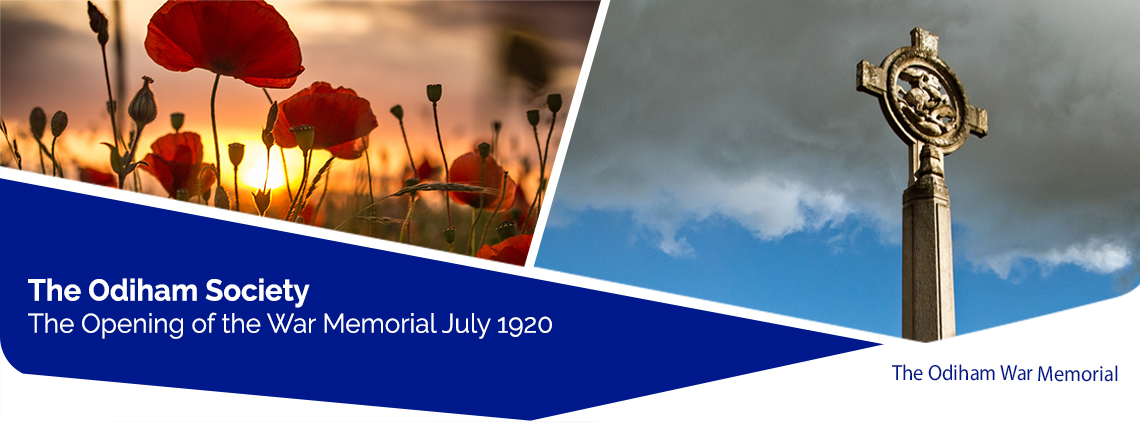
The memorial has been appropriately designed for its position on the main road through the town and is in Portland stone, having a moulded base with an octagonal shaft about 15ft high. On top of the shaft stands the cross with a finely carved figure of St George and the Dragon inside the circle. On the front of the base stone a sword surrounded by a laurel wreath is carved, beneath which is the inscription. At each side of the base stone tablets of Portland stone have been fixed bearing the names the fallen and their regiments. The side return walls are of sand stock bricks, with a plain stone band, and a coping of stone on top. The approach to the monument from the main road is by five stone steps and access from the back is given by two opening left in the surrounding walls. The whole of the work has been carried out to the design of Mr P. Morley Horder, architect, 5, Arlington Street, St James’s, London, by Messrs. Benfield and Loxley, contractors, Oxford.
It was unfortunate that rain fell during the ceremony, but not withstanding this a very large assembly gathered at the spot, the shops being closed for the time being. A procession was formed in the Bury, headed by the Odiham Oaks Band, and marched down the street to the memorial cross, where the various persons interested took up the positions assigned to them. Boys and girls holding laurel wreaths which had been made by members of the Women’s Institute stood in the street facing the cross. Behind them were the Cadets in charge of Captain C.H.S. Wilson and Lieut Bimmington. On the sidewalk at the back of the memorial were the Girl Guides in charge of Miss Bessell and Miss Wright. The Vicar (Rev J.P. Baynes) and the Rev. S.J. Robins stood on the top of the steps in front of the cross, and a large assembly stood round about. Among others present were Mr J.L. Brooks (chairman of the War Memorial Committee), Sir Gerald Mildmay, Bart., Lady Mildmay, Miss Chamberlain, Miss Ida Chamberlain, Mrs de Courcy Daniell, the Hon. Charles and Mrs Sclater-Booth, Mrs Guy Sclater, Capt. Petre, Lady Palmer, Gen. Philpott, Rev. R.E. Healet, Mrs and Miss Healey, Mr. Gotelee (hon. secretary to the Committee), Mrs Gotelee, Mr E.A Jarvis (hon. treasurer), Major A.W. Gale, Mr H.W. Thomas, J.P., C.C., Mrs and Miss Thomas, Mr H.W. Collett, Mr P. Fountain, Mr S.H. Clinker, Mr W.P. Kensett, Mr A.R. Hunwick, Mrs and Miss Saunders, Mr A.B. Pratt, Miss Pratt, Miss Jenkins, Mr J.W. Choules, Mr W. McIndoe, Mr W.H. Wright, Mr E.W. Sainsbury, Dr T.H. and Mrs Davison, and Mr A.H. Jones (Oxford), representing the contractors. Mr Hayward and Miss Francis were with the children holding wreaths, most of whom belonged to the families of the fallen. The Rev. S.J. Robbins began the ceremony with the scriptural sentence, “Greater love hath no man than this, that a man lay down his life for his friends.” The Lord’s Prayer was said by the people and the hymn, “O God, our help in ages past” was sung, led by the short speech by Mr JL Brooks chairman of the war memorial committee
SHORT SPEECH BY Mr JL BROOKS
Chairman of the War Memorial Committee
“Fellow parishioners of Odiham, before I ask Lord Wolmer to unveil this memorial I should like to say a few words. In the spring of last year, a public meeting was held at which was discussed how we should celebrate the great victory which we obtained. Various suggestions were then made, but none found more favour than that we should erect some memorial to perpetuate the memory of those men who had fallen in the Great War and who had gone forth from this parish. The Committee, I am glad to say, had a spontaneous response to their appeal and plenty of money I hope has been subscribed to pay for this memorial. They then had to consult an architect and were recommended to Mr Morleg Horder, who has undertaken similar work in various parts of the country. You see now the result of his efforts. He was particularly anxious to make something which would tone with the buildings in this old street, which he admired greatly, and he has therefore incorporated similar brickwork in this memorial. Time will do the rest. The design you see. Perhaps some of you do not like it. Some do not like the position. But we hope that the majority in years to come will appreciate the effort the architect has made. It was suggested that this memorial might be put in the cemetery or the churchyard, but the Committee thought that was not a suitable place for it. We did not want to put it in a resting place for the dead, but in the busy scene of our daily life in this old street. I trust it may be a lasting memorial and that as we pass daily up and down this old street we may remember the men and women whose names are inscribed on these tablets, and be grateful to them for their efforts to maintain the glory of old England and to save our homes from devastation and ruin. I trust that this place may be treated with respect and reverence; that it will not become a playground for children nor be made a place of gossip for people of older age. I hope this memorial will be appreciated by the parishioners and may be a lasting tribute to those from this parish who have fallen in the service of their country. I will now ask Lord Wolmer to unveil this memorial, but before doing so I should like to thank him very much for coming here. I also want to thank the Oaks Band for playing the procession down the street and for playing the hymns. No other thanks are necessary, because I know everybody else is here from a high sense of duty.”
ADDRESS BY LORD WOLMER MP – Unveiling the War Memorial
“We are met here, on a very solemn and memorable occasion, and it is well that you children are here so that you shall remember it I hope for a long life and tell your children and your children’s children why this beautiful cross has been erected in our midst.These memorials of the terrible war adorn every English town and village throughout our countryside. They stand to us as perpetual reminders of the men and women who hesitated not to lay down their lives for right and for England. Their name liveth for evermore. Memorials to them are not necessary to us, nor shall they be necessary to England in future history; but they are the only tribute in stone and brick that we can pay, and we pay it so that no one should think that we for a moment are ever unmindful of these heroes and heroines, and that this memorial may be to the people of Odiham and to all who pass by a perpetual reminder of the example that these men and women have set. For an example was set by every man and woman who answered their country’s call. All who went forth to the Great War offered a sacrifice. God accepted it of some. Pride and again pride and thankfulness must I think be the prevailing sentiment. Let there be no regrets. Put away selfish grief. Render thanks that God sent us such men and women. Render thanks that England can still produce such sons and daughters. Above all, count not their lives wasted. They have done more in their lives and by the example they have set than we can ever hope to do. They have shown to the whole world that England counted right above might, that English men and women were not afraid to die for duty. They have maintained the tradition of former generations of English people and have set an example for future generations to follow. It is not the richness of the soil, it is not our great harbours or our manufacturing towns or our geographical position that has made England the mistress of a mighty Empire. It is the character of our people, the character of a God- fearing and strenuous people that has placed us where we are. That that character is as true to-day as ever it was those men and women have shown; and so long as their memory is green so long will there be others to follow in their footsteps. Their death is England’s life. Their triumph, their sacrifice is the victory of all that is right, of all that is honest, of all that is true. Honour, eternal honour to their name. Thanks to God for sending them. And may we and those who come after us endeavour to be worthy heritors of what they have left us, so that it shall never be said that this was sacrifice was made, that this example was set to an unworthy England or to a heedless generation. They have given us a priceless heritage. Let us preserve it. Let us uphold it. Let us offer it to Almighty God for the glory of His Kingdom.”
The unveiling of the Odiham War Memorial & Wreath Laying 3 July 1920
Lord Wolmer then pulled a cord and the Union Jack which covered the base of the cross was drawn aside, exposing to view the following inscription, which he read: “To the glorious memory of the men and women of the parish of Odiham who gave their lives for their King and country in the Great War 1914-1919. Proud and grateful parishioners have here recorded their names.”
The Vicar, Rev. J.P. Baynes, V.D. (who served as chaplain during the war) then said a prayer and proceeded to call the roll of those whose names are inscribed on the tablets. As he did so, four at a time, the children walked up the steps and handed their laurel wreaths to Mrs Daniell or Miss Ida Chamberlain, who arranged them round the base of the cross. Each wreath was tied with red, white and blue ribbons and bore the name of one of the fallen.
Two stout buglers then sounded “The Last Post,” and the Vicar pronounced the Blessing, and the ceremony ended with a verse of “God Save the King.”