
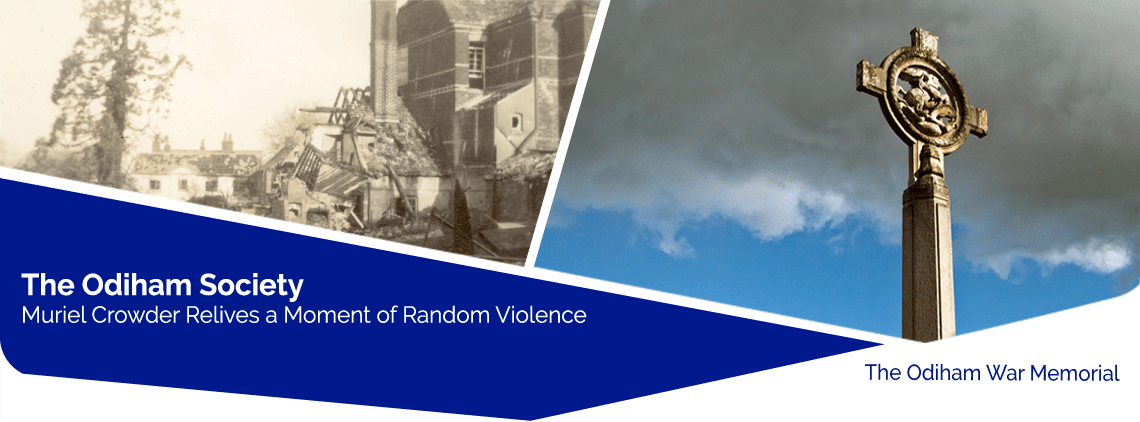
A MOMENT OF RANDOM VIOLENCE
MURIEL CROWDER UNVEILED THE ODIHAM SOCIETY COMMEMORATIVE PLAQUE ON 18TH OCTOBER 2015
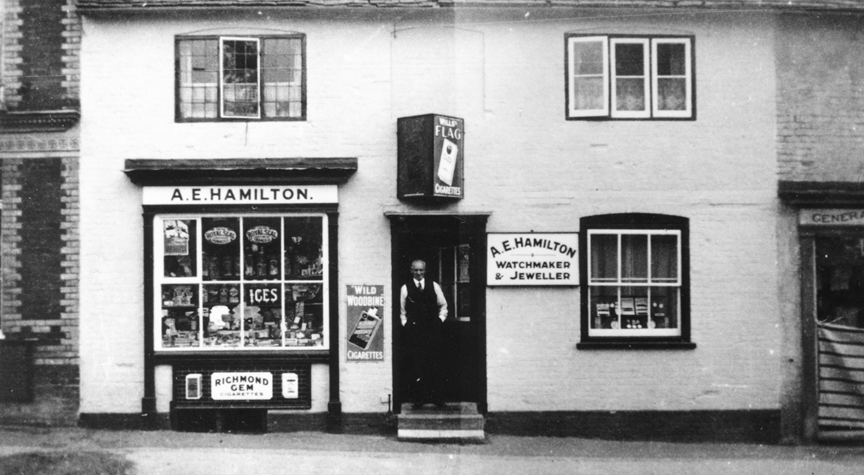
Hamilton’s Sweet Shop Before the Bombing
It was Friday October 18th 1940 and at 3 pm my life was dramatically changed.
I was working as a GPO telephonist at the telephone exchange in The Bury, Odiham (now a private dwelling) when a lone aircraft passed overhead. It was a German bomber and it dropped four bombs, which landed on the corner of Church Street and High Street. No warning had been given as planes passing overhead were far from unusual because of the day-by-day activity from the nearby RAF airfield
Imagine the shock and horror my colleagues and I felt with the powerful explosions that were so near and seemed to rock the building – we could hardly imagine what damage might have been caused or where it happened. I said to the others: “Do you mind if I run home to see my parents to tell them I’m all right?”
My home was next-door-but-one from the corner of Church Street where we had a watch making and confectionary shop. I ran across The Bury and as I reached Church Street the whole road was filled with rubble while water from burst water mains was fountaining skywards. There were workmen already sift ing through the rubble. ”You can’t come down here, love”, they said. I called back, “I have to, I live here and I want to get to my parents!” Two men came forward and lifted me shoulder high over the rubble to the bottom of the road. I discovered to my utter horror that Maybanks, the draper’s shop on the corner, had completely disappeared and with it half of my house. I scrambled over the rubble and found my dad clambering about in a complete daze. He was covered with brick dust and debris and, when he saw me, said “I’m looking for your mother. I can’t find her.”
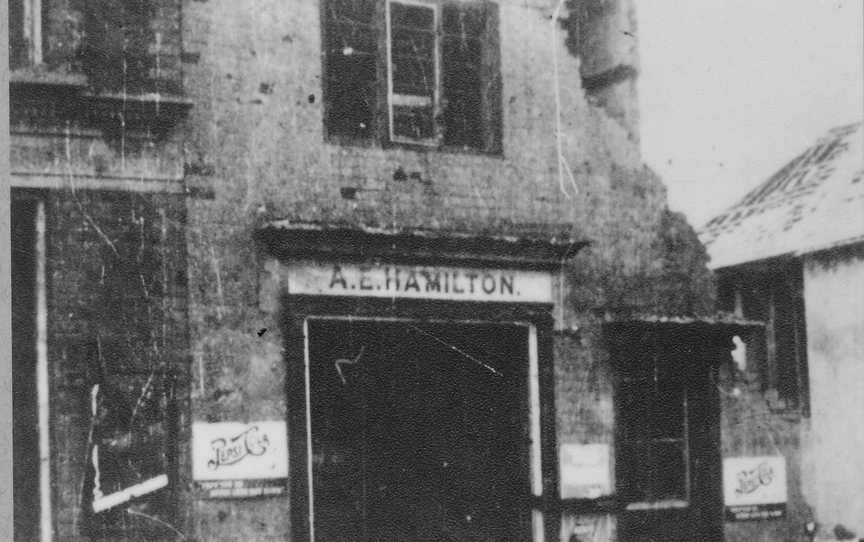
Hamilton’s Sweet Shop After the Bombing
The staircase was still in place, so I ran up and opened the bedroom door, but there was a sheer drop and an empty space on the other side! Half the house had been completely demolished. Dad and I couldn’t find Mum but by then emergency services had arrived and were setting to work shifting debris and looking for bod1es. They told us that they had to get on with the job and that we would have to go away. After telling them where we would be I took my father to the exchange where we were given tea and looked after by the kind caretaker who was also a friend of my mother.
So why had a lone German aeroplane dropped its bombs on the town? One possible explanation was that the pilot had been looking for the RAF station but had spotted cadets at Robert May’s Grammar School parading in the playground and might have thought it a military facility of some kind. Thankfully he missed the school but unfortunately hit our home instead.
I telephoned my sister Ida and her husband Harold West, who ran the garage in North Warnborough and lived in the adjoining house. I also sent a telegram to my brother who was serving overseas in the army. My sister tried to drive her car up Dunleys Hill but could go no further than the Regent Cinema (where there is now a Texaco Petrol Station and some houses) because the rubble from the houses had somehow been blasted all that way. So she left the car and struggled on by foot to reach The Bury.
Comforting each other, we now had an awful wait for news, hoping and praying that mother would still somehow be found alive. We learned later that five bodies had been taken together with several injured people to Odiham Cottage Hospital. Harold, my brother-in-law, went to identify the victims and found that mother was indeed one of the five fatalities. She had been killed instantly. He came back to the exchange with the dreadful and devastating news and in an instant, my world crumbled. Dad and I went back to North Warnborough to stay with Ida and Harold where she gave us a home until we could decide what we should do.
I was only 18 at that time and could not imagine life without Mum, who was only 54. I felt completely desolated. Eventually, Dad found premises where he could continue his watch-making trade together with comfortable accommodation in Odiham High Street. Six years later he married my mother’s friend from the telephone exchange. The family was overjoyed and glad that he had found companionship and comfort in the later years of his life. I stayed on with my sister who already had a daughter of four years and was expecting another child. My work at the telephone exchange continued and as time went by I came to the realisation that life goes on after all and I could deal with my future.
To cut a long story short, I met my future husband, Gordon, who was in the RAF. He was sent abroad, serving on the continent until peacetime, coming home in October 1946. We were married in All Saints Church in Odiham on January 1st 1947. We first lived in a flat in Hook Rectory (now Berrie Court) and our son Ian was born in 1949. We moved to a larger home at The Holt, down Holt Lane, and in 1952 our daughter Judith was born. Our next move came in 1956 when we move to The Gables in London Road, where we have lived ever since.
In 1948 Gordon entered Teacher Training College and began his career at Hook Junior School ( the old school opposite the Hogget pub) then in various other North Hampshire schools, finishing at St Peters, Yateley.
My mother’s name is inscribed on the War Memorial in Odiham High Street, together with the others killed by enemy action, and their names are read out in All Saints Church on Remembrance Sunday.
My Mum’s name was Helen Hamilton and, in addition, her name is read out in St John’s Church in Hook on Remembrance Sunday. It is comforting that her name lives on in this way, bringing happy memories of the Mum I adored.